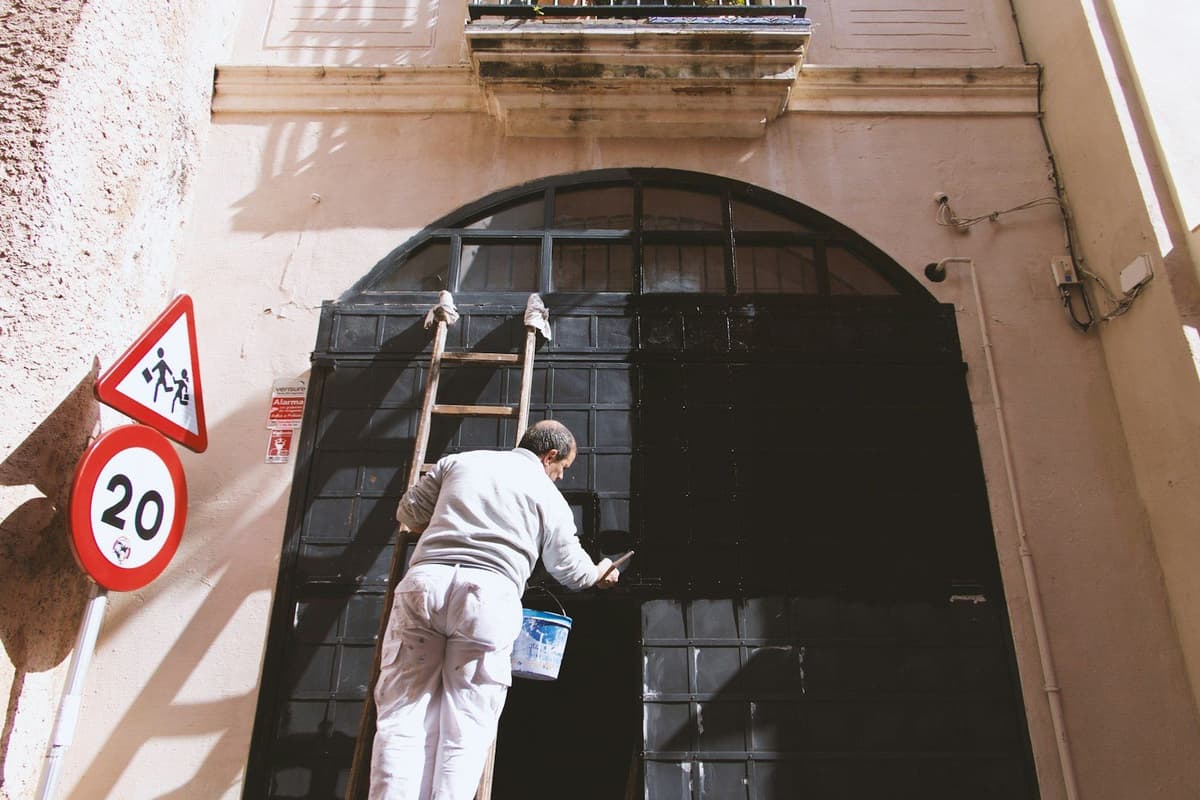
Painting your home's façade is not just an aesthetic matter. It is an investment that can last a decade or start to peel within two years, depending on a factor that many property owners overlook: the exact moment when the paint is applied.
Climatic conditions are decisive: the temperature must be between 5-30 °C, relative humidity below 75 %, and it must not rain in the 24-48 hours following application. Skipping these recommendations has real technical consequences, ranging from poor adhesion to the formation of bubbles or permanent stains.
How temperature affects the final result of exterior paint
The surface temperature of the façade at the moment of paint application determines the drying speed. When the surface exceeds 35 ºC or is in direct sunlight, drying is so rapid that the paint (especially plastic and acrylic types) does not have time to level out, leaving brush or roller marks and poor adhesion1. The problem is especially common on south-facing façades in cities like Seville, Córdoba or Murcia during July and August.
At the other extreme, temperatures that are too low are also unsafe. Applying paint with less than 5 ºC slows down the chemical curing of acrylic products, which prevents the protective film from forming properly. In inland regions like Teruel, Soria or Ávila, this limits the working window to late spring and early autumn.
In Madrid, spring (April-June) and autumn (September-October) offer ideal conditions: temperatures between 10 °C and 30 °C and low humidity. This same pattern can be applied to most of the Castilian plateau and Aragón.
The role of relative humidity and rainfall
Humidity is the second critical factor. Although we associate summer with dryness, coastal mornings and nights can actually have very high relative humidity. Applying paint with more than 80-85 % humidity slows down the evaporation of water and solvents, preventing proper drying and generating stains, loss of shine and, in the long term, blisters.
In areas of northern Spain, such as Galicia, Asturias, Cantabria or the Basque Country, humidity and frequent rain require careful planning. It is not enough to avoid painting when it rains: it is essential to ensure that it will not rain in the 48 hours following application. Otherwise, water carries away the fresh paint or causes irreversible stains.
Mediterranean coastal areas present another challenge: air salinity. In cities like Alicante, Valencia, Tarragona or Málaga, sea breezes carry salt particles that can interfere with paint adhesion if applied on very windy days or with sea spray.
Regional climate differences: when to paint in each area of Spain
Each Spanish region has its optimal window, and knowing it avoids surprises:
Valencian Community and Mediterranean coast
Summer, with its long days of sun and scarce rainfall, is traditionally popular for exterior painting, but the Mediterranean climate presents specific conditions that, if not handled correctly, can compromise the result and durability. It is best to schedule work in the early morning or late afternoon, when the surface temperature has dropped.
Andalusia and areas of intense heat
In Seville, Córdoba, Jaén or Badajoz, summers regularly exceed 40 ºC. Painting in those conditions is technically risky. Spring (March-May) and autumn (October-November) offer the best conditions. Even winter can be viable on the Andalusian coast, where temperatures rarely fall below 10 ºC.
Northern zone (Galicia, Basque Country, Asturias, Cantabria)
Here the challenge is not heat, but constant rain and humidity. The months of June, July and September are usually the driest, but even then it is essential to check the short-term weather forecast before starting. A sunny day can turn into a drizzly afternoon without warning.
Inland peninsula (Madrid, Castile and León, Castile-La Mancha, Aragón)
Madrid's climate, with very dry summers, intense sun and winter frosts, requires specific exterior paints. The ideal window is April-June and September-October. In winter, nocturnal frosts can ruin a freshly completed job, even if the temperature is acceptable during the day.
What to do if you cannot wait for the ideal season
Sometimes you have to paint outside the optimal window: a leak requires urgent intervention, or a neighbourhood community can only close dates in August. In those cases, the professional can adapt the work:
- Apply paint during the coolest hours of the day (before 10 in the morning or after 6 PM in summer).
- Choose products formulated for extreme conditions, such as siloxane or elastic paints that better tolerate thermal variations.
- Increase the number of coats or adjust drying times between coats to compensate for adverse conditions.
- Work only on façades that are in shade at each time of day, and rotate as the sun moves.
These adaptations increase working time and often the cost, but are preferable to a poor result that forces you to repeat the work the following year.
Plan the work in advance, do not improvise along the way
The key to taking advantage of proper climatic conditions is planning ahead. If your façade needs painting, do not wait for serious peeling to appear. Request quotes in winter for spring work, or in summer for autumn projects. This gives you room to choose dates with favourable weather forecasts and avoid last-minute rush.
When you speak with professionals, ask explicitly how they will manage climatic conditions. A serious painter will always check the forecast before starting, delay the work if conditions are not safe, and explain why. Be wary of anyone who promises to start tomorrow without checking whether it will rain the day after.
On our platform, verified professionals know the optimal working conditions in their area and plan projects based on local climate. That is part of a serious quote and a result that truly lasts.
Ready to paint?
Get free quotes from verified local painters in minutes. No commitment.
Sources
External sources open in a new tab.